Arithmetic and algebra


Data Sheet

CLASSES: 6, 7 and 8.
Skills:
The pupil:
- recognises and solves problems in different contexts, assessing the information and its consistency;
- explains the process followed, also in writing, keeping track of both the solving process and the results;
- compares different procedures and produces formalisations that allow them to move from a specific problem to a class of problems.
METHODS:
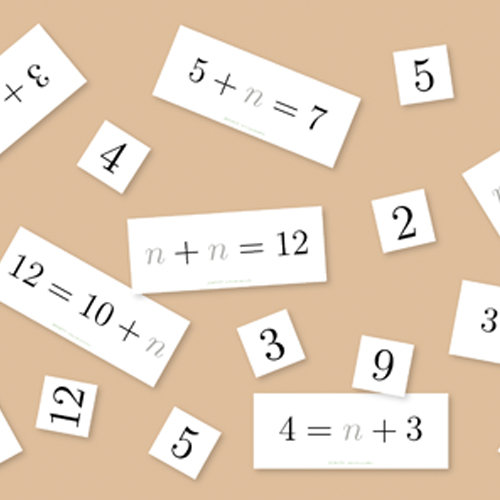
The pathway asks pupils to find solutions of equations and simple inequalities. The classic techniques of algebra are not used: pupils proceed by trial and error. Proceeding by trial and error means reaching a solution gradually, without penalising mistakes. In teaching practice, mistakes are often associated with failure, because teaching is sometimes seen as training and therefore based on reproducible procedures (Zan & Di Martino, 2017). But avoiding mistakes limits the chance of dialogic learning, based on comparing truth and falsehood. Recent research has shown that placing deliberately wrong worked examples next to correct ones helps students learn (Rushton, 2018). In this pathway, the trial-and-error approach pushes the class to look for a strategy to reach the solution faster, which helps them understand the topic.
This pathway was designed by Luigi Bernardi and Giorgia Damiano.

Data Sheet
CLASSES: 6, 7 and 8.
Skills:
The pupil:
- recognises and solves problems in different contexts, assessing the information and its consistency;
- explains the process followed, also in writing, keeping track of both the solving process and the results;
- compares different procedures and produces formalisations that allow them to move from a specific problem to a class of problems.
METHODS:
The pathway asks pupils to find solutions of equations and simple inequalities. The classic techniques of algebra are not used: pupils proceed by trial and error. Proceeding by trial and error means reaching a solution gradually, without penalising mistakes. In teaching practice, mistakes are often associated with failure, because teaching is sometimes seen as training and therefore based on reproducible procedures (Zan & Di Martino, 2017). But avoiding mistakes limits the chance of dialogic learning, based on comparing truth and falsehood. Recent research has shown that placing deliberately wrong worked examples next to correct ones helps students learn (Rushton, 2018). In this pathway, the trial-and-error approach pushes the class to look for a strategy to reach the solution faster, which helps them understand the topic.
This pathway was designed by Luigi Bernardi and Giorgia Damiano.
Julia Robinson

 Julia Robinson was an American mathematician who worked on mathematical logic, the theory of equations, the theory of algorithms and game theory.
As a child she missed two years of school because of illness, but she caught up in just one year. Later she earned her doctorate under Alfred Tarski, one of the best-known mathematical logicians of the time.
Julia Robinson then taught mathematics, logic and statistics at the University of California, at its prestigious Berkeley campus.
She received many honours in her life. In particular, in 1982 she was President of the American Mathematical Society, the scientific society that brings together the mathematicians of the United States.
She died of leukaemia.
Julia Robinson's most important result concerns the “decision problem” for certain equations. At secondary school we learn how to solve linear and quadratic equations. It is easy to see that, even when all the coefficients of an equation are whole numbers, the solutions may not be (just think of 2x = 1 or x2 = 5).
On the other hand, in many practical situations only whole-number solutions matter. For example, some problems ask for the number of people at a party, or the number of lorries needed for a delivery (in these problems a student sometimes answers, without thinking too hard, 3.5 lorries!).
Now think of equations with more than one unknown, such as x3 – 2y2 = 5, or even longer and more complicated ones. Finding a solution of the equation is not too hard: I give x a value of my choice, say x = 3; then, after a few steps, I find that y = √11. But... is there a solution where both x and y are whole numbers? I know no formula, as there is for quadratic equations; I can only proceed by trial and error. In this case I am lucky, because there is a solution with fairly small numbers: x = 7 and y = 13. Indeed, 73 – 2×132 = 5.
In general, however, trial and error is risky, because you may go on for a long time without finding anything. When do you stop? And if you stop and give up, you are left wondering whether you stopped at just the wrong moment, when you were about to find a solution.
In 1900 the great mathematician David Hilbert explicitly posed the problem (known as Hilbert's tenth problem): find a general procedure that, given an equation, tells whether it has at least one whole-number solution.
The problem is extremely difficult, and it was solved only in 1970. Four great mathematicians contributed to the solution: Martin Davis, Yuri Matiyasevich, Hilary Putnam and Julia Robinson (which is why some people speak of the DMPR theorem). And, contrary to what one might have hoped, the answer is “negative”: the general procedure Hilbert asked for does not exist! Even with the best computers in the world, no one will ever be able to design software that decides whether an equation has whole-number solutions (a procedure exists only for particular kinds of equations).
Two important remarks. First, the result came from the collaboration of four researchers, each of whom made an essential contribution. A single researcher, however brilliant, would hardly have reached the solution alone.
Second, the result, as we said, is negative. Mathematics is often seen as the subject where you calculate, solve and prove; but even mathematics has its limits. And mathematical logic has sometimes managed to pin down exactly those limits: there are problems (like this one) that no one will ever be able to solve. It may sound discouraging. In fact, a “negative” result is often very fruitful, because it opens the way to further research, ever deeper and more fascinating.