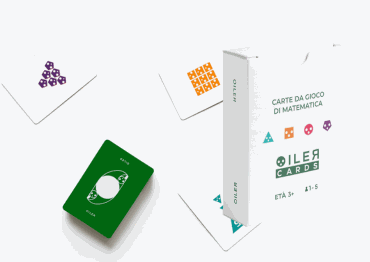
OILER CARDS are maths-themed playing cards for children aged three and up. A deck of OILER CARDS has 44 cards, divided into 4 suits, each with cards from 0 to 10. The cards do not show the number written in digits, only the quantity. The four suits are blue, yellow, purple and red. In each suit, the arrangement of the units depends on the topic area it refers to:
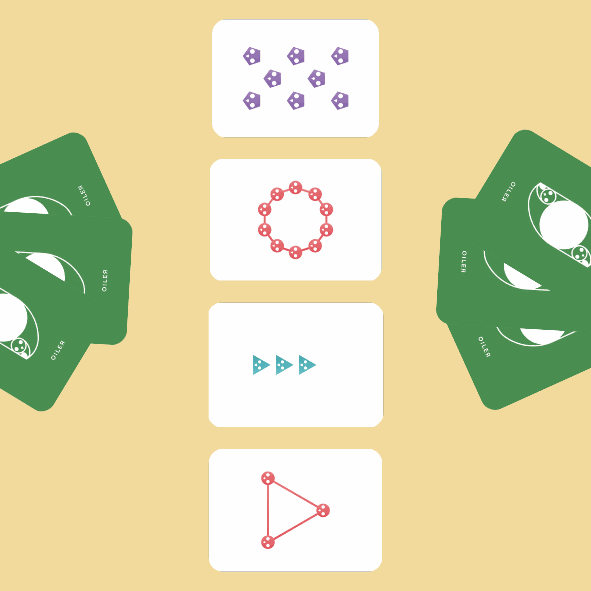
- red refers to the topic area space & shapes. For example, the units of the number three are placed on the vertices of an equilateral triangle and those of the number four on the vertices of a square.
- purple refers to the topic area relations, data and predictions. The units are sometimes arranged as on dice, sometimes as on standard playing cards, and sometimes as triangular numbers.
- yellow refers to the topic area numbers. The units are arranged following a multiplicative decomposition.
- blue refers to the topic area logic. The units are arranged to highlight groups of 5, following the counting system of the Soroban abacus. The 10 is shown as one ten.



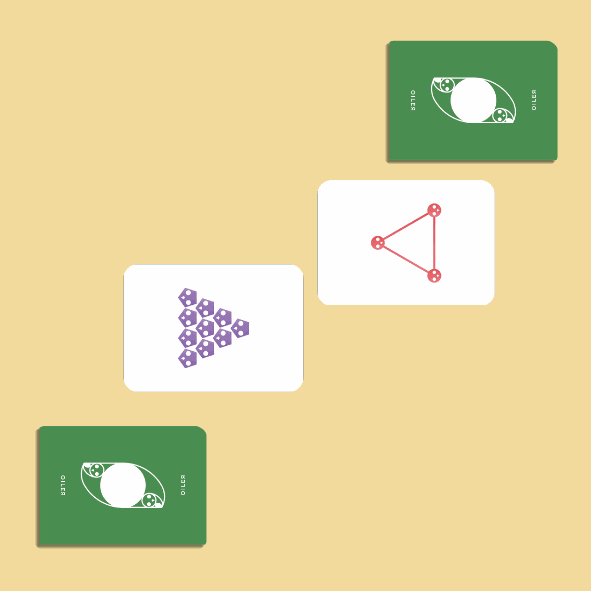
WAR

2-4 players
In the event of a tie (that is, if the highest card appears more than once), the players with that card shout “war!”, place four cards face down on the table and turn over the fifth. Whoever has the highest of these fifth cards wins the turn and takes all the cards on the table (including the four face-down cards placed by each player who had the highest card), putting them at the bottom of their pile. Whoever runs out of cards loses: the last player left wins the game.
The game can be played with children aged 3 and up, putting only the cards from 0 to 4 in the deck at first (20 cards in all). The number of cards is then gradually increased until the whole deck is used. When playing with only 20 cards, it is best, when a war happens, to place only 2 cards face down instead of 4.
Variations:
- Instead of the word “war!”, you can use similar expressions linked to what the class is working on, such as “as many as, war!” or “equal, war!”;
- instead of one card per turn, each player plays two cards per turn: whoever has the highest sum takes the cards. This variation is useful for practising mental arithmetic.
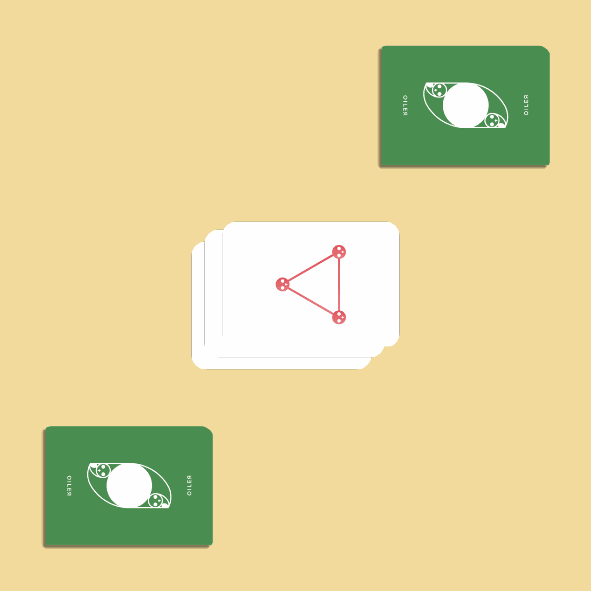
ONE, TWO, THREE!
2-4 players
If two consecutive players discard a card of the same value, so that, for example, two 7s appear in a row on the pile, all the players must rush to put a hand on the pile. The first player to put their hand on the pile takes all the cards in it and puts them under their own pile. Whoever runs out of cards loses. The last player left in the game wins.
Variations:
- Add the classic rule of the game ONE, TWO, THREE! If a player plays a 1, a 2 or a 3, the next player must play one, two or three cards in a row, one at a time. If that player does not play a 1, a 2 or a 3, the first player takes the whole pile. If, while the second player is turning over the cards, a 1, a 2 or a 3 comes up, play passes immediately to the following player, always in the same way. The last player to have played a 1, a 2 or a 3 takes the whole pile. Here is an example to make this clear. Player A plays a 2. The next player, B, must put two cards on the pile: first an 8, then a 3. At this point, play passes to the following player, C, who must put down three cards: C discards 5, 8 and 6, in this order. As no 1, 2 or 3 came up among C's cards, player B takes everything.
This new rule is logically complex, but it can be introduced from Grade 1 to train reasoning.
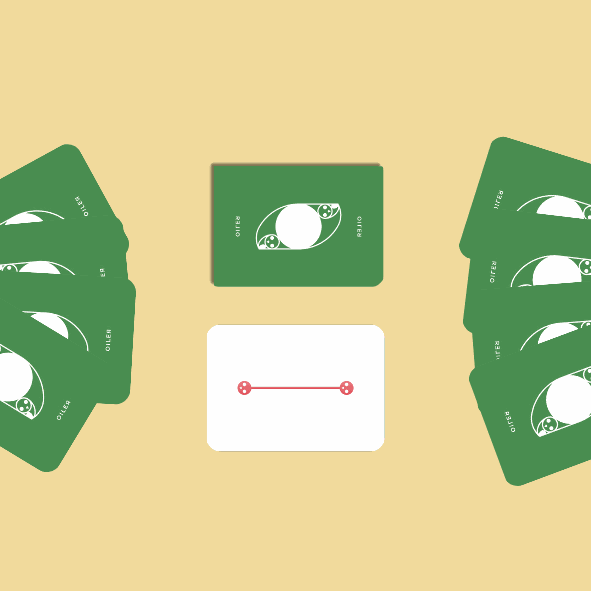
DERNIER (UNO)
3-5 players
A zero can be put on any card (in a sense, zero belongs to every colour). After playing a zero, the same player plays another card of their choice, of any colour, and then passes the turn. So the zero works as a colour change. A player left with one card in hand must shout “dernière!” (French for last). Whoever runs out of cards first wins.
Variations:
- To make the game simpler and playable in kindergarten too, the rule is that only cards of the same colour as the face-up card can be played. Once the children have understood how it works, add the option of also playing cards of the same value as the face-up card;
- some cards are given special powers: for example, every time a 10 is played the direction of play is reversed, or every time a 9 is played the next player misses a turn, unless they play a 9 in turn. Another idea is that every time a 1 is played, the next player draws three cards, unless that player also plays a 1, which forces the following player to draw not 3 cards but 6. Of course, the class can invent the effects of each card.
SCOPA
2-4 players
Always starting from the player who was dealt cards first, each player can capture a card on the table with one of their own if the two cards have the same value, and put both aside in their own pile. A player who cannot capture any card on the table must discard one of their cards, adding it to those on the table. When all the players have used up their three cards, three more cards are dealt to each player. Play continues until the deck runs out. If in the last round it is not possible to give 3 cards to each player, the remaining cards are dealt until there are none left. If any cards are left on the table at the end of the game, the last player to have made a capture takes them all. The player who captures the most cards wins.
Variations:
- Add the rule that two or more cards on the table can be captured with a card whose value equals their sum. In particular, a 0 can always be captured as an addend of a sum. This variation is useful for practising mental arithmetic;
- gradually add all the rules of scopa: scopa, settebello, denari (yellow cards), primiera. Taking the most cards is still worth one point and the points from the other rules are added: whoever scores the most points wins.
PRODUCT
2 players
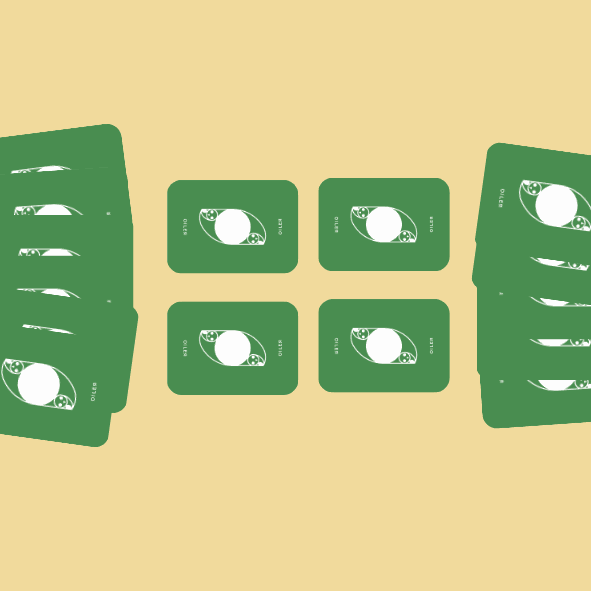
The cards are turned over at the same time: whoever has the higher product of their numbers wins all four cards and puts them aside. For example, if the first player has a 4 and a 1 and the second player has a 2 and a 3, the second player, having the higher product, takes all four cards and puts them aside.
Play continues as long as the players have cards in hand (three plays in all), then 6 cards are dealt to each player again. In the last round, each player is given four cards. The player who has taken the most cards during the game wins.
BRISCOLA
2-4 players
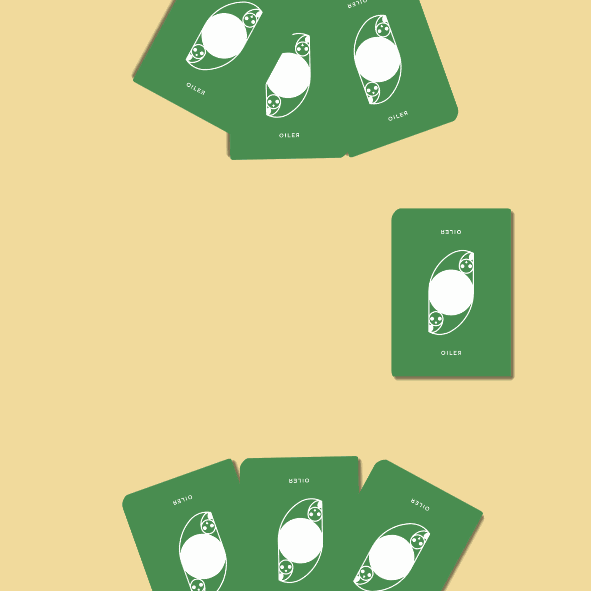
The player who leads plays a card of their choice; the others do not have to follow suit and can play any card. The trick goes to whoever played the highest card of the suit led. Here is an example in a four-player game: the first player plays a yellow 5, the second a blue 8, the third a yellow 7 and the fourth a yellow 2. The third player, who played the yellow 7, wins the trick.
Variations:
- Add the idea of the briscola, the trump suit. In the first hand, after the cards have been dealt, one more card is turned over and placed face up at the bottom of the deck. This card shows the trump suit, that is, the suit that beats the other suits. Here is an example, assuming that purple is trumps. The first player plays a blue 8, the second a blue 9, the third a purple 2 and the fourth a purple 5. The fourth player wins the trick, having played the highest trump. The last card, the face-up one, goes to the last player to draw in the game.
- in a four-player game, add the idea of playing in pairs: each player plays with the player sitting opposite. The rules are the same, but at the end of the game each pair adds up the points scored by its players.
- instead of the player who takes the most cards winning, points are given to particular cards: the 10 is worth 10, the 9 is worth 9, down to the 5, which is worth 5. The other cards are worth nothing. Whoever scores the most points wins.
TRESSETTE
2 or 4 players
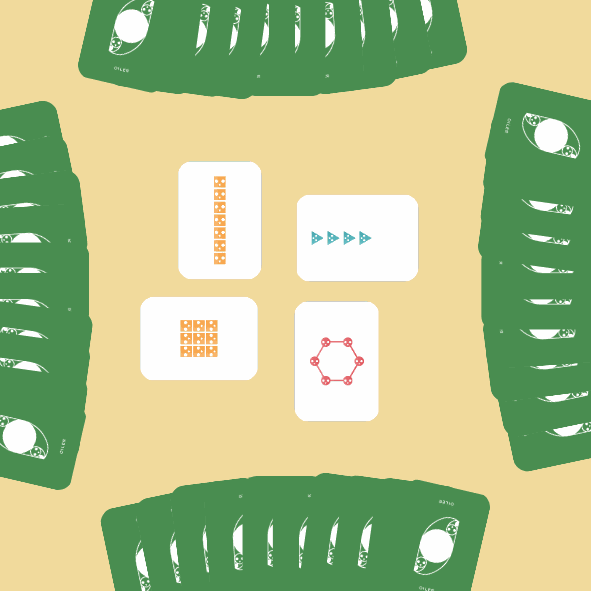
With two players, each is dealt 11 cards. The rest of the deck is placed face down on the table. The player who was dealt to first plays a card and the second player, if they can, must follow suit (playing a zero is always allowed). Whoever played the higher card takes both cards and puts them aside. If the second player cannot follow the suit played by the first player, they will certainly not take the cards. For example, if the first player plays a blue 2 and the second player, having no blue cards, plays a red 8, the first player takes them. A 0 takes the trick only if the second player also plays a 0. After each hand, each player draws a card, starting with the player who took the last trick; the card drawn is shown to the other player. The player who takes the most cards wins.
With four players, the game is played two against two. All 44 cards are dealt among the four players, who form two teams, each player partnering the person sitting opposite. The first player leads a card of their choice and the other players, if they can, must play a card of the same suit.
The player who played the highest card of the colour led takes the four cards on the table. Whoever takes the trick leads the next turn. The pair that has taken the most tricks wins the game.
Variations:
- The 8 is worth one point. So there are 5 points in all: one for whoever takes the most cards, and one point for each 8 taken (there are four 8s in the deck). During the game it is therefore very important to take as many 8s as possible. A strategy the students will discover, in the four-player version, is that if your partner is about to win a trick and you cannot follow suit, you can play an 8 of another suit: since your partner will take the trick, the pair secures a point;
- one extra point goes to whoever takes the last trick. So there are 6 points in play: one for the cards, four for the 8s and one for whoever takes the last trick;
- the cards 10, 9, 7, 6 and 5 are worth a third of a point each, and the point for taking the most cards is removed. So the points in play are: 4 points for the 8s, 6 and two-thirds points for the other cards, and one point for whoever takes the last trick. Final scores are always rounded down: if a player scores 5 and two-thirds points, only 5 points count. This variation lets you work on fractions.
TRIUMPH
4 players
For the first games of Triumph, you can play with the basic rules of Tressette given in the previous section: the pair that takes the most cards wins. Little by little, introduce all the variations of Tressette: the 8 is worth more, whoever takes the last trick scores an extra point, and some cards are worth a third of a point.
WHIST
3 or 4 players
Let us look at the rules in more detail. The game is played over several rounds: in the first round the four players have one card each, in the second round two cards each, in the third round three cards each and so on, up to the eleventh round, in which the players have 11 cards each (this last round is made up of 3 or 4 deals, as we will see later). Start by dealing one card to each player and turning over the top card of the remaining deck. The card turned over shows the trump suit. The players look at their card and, starting from the player who leads, they bid, that is, they say how many tricks they will take (in this case, either one or zero) based on the card in their hand. For example, if yellow is trumps and a player holds the yellow 10, they will certainly take the trick, so they will say “one trick”. Even with a yellow 7 in hand, the player is very likely to take the trick, so they will still say “one trick”. On the other hand, if a player holds a red two, they are very unlikely to take the trick, so they will say “zero tricks”. Then comes the playing phase: starting from the player who leads, all the players play their card and you see who takes the trick (if no trumps are played, as in Triumph or Tressette, the suit led wins). Points are always given in this way: a player whose bid is right scores 10 points; a player whose bid is wrong loses 5 points for each trick taken more or fewer than the bid. In addition, a player whose bid is right gets 5 extra points for each trick taken.
The game continues by dealing two cards to each player and turning over a card, which shows the new trump suit for this round. Then comes the bidding: the players can say zero (they will take no tricks), one (they will take exactly one trick) or two (they will take both tricks). Play then continues as in a normal game of Triumph.
Here is an example of how points are given: in the round with seven cards per player, the situation is as shown in the table.
PLAYER |
BID |
TRICKS TAKEN |
POINTS IN THE ROUND |
A |
three tricks |
three tricks |
25 = 10 + 3 × 5 |
B |
zero tricks |
two tricks |
− 10 = 2 x (− 5) |
C |
zero tricks |
zero tricks |
10 |
D |
three tricks |
two tricks |
− 5 |
The game continues until the last round with 11 cards, in which there are as many deals as there are people playing. Indeed, when all the cards have been dealt to the players, it is no longer possible to turn over an extra card to choose the trump suit: in each deal, the player who leads chooses the trump suit after looking at their cards (in each deal a different person leads).
Variations:
- Introduce the typical rule of Whist: the last player to bid cannot say the number that would make the total of the predicted tricks equal to the number of cards in each hand. Here is an example with four players in the round with two cards per player: A bids 1, B bids 0, C bids 0; at this point D cannot bid 1, because the total of the tricks would be exactly 2, the number of cards in each hand. So D can bid either 0 or 2 tricks.
Asking students to change the rules of familiar games, or to create new rules to add to the others, is a very important activity. It puts students in “research mode”: they make hypotheses (“what happens if…?”), try them out, observe and study the effects of the change of rules, and argue about why a rule is more or less interesting and what consequences it has. The class thus practises recognising the central idea of a game: they understand the reasons behind the original rules and develop deeper thinking about games in general, analysing how their strategy changes when the rules change, or whether there are invariants, that is, something that does not change even when the rules vary. This is also why it is important to introduce the rules of a game little by little, so that each addition can be discussed collectively with the class.
Take the game War as an example and let us analyse two variations and their effects. You can decide that during the game the cards go not to the highest card but to the lowest. If you think about it, you notice that this variation does not change the logic of the game at all. Another variation of War consists in changing the number of cards placed face down during a war: you notice that the more cards are placed, the faster the game becomes.
- Contrast: to experience something, you need to experience something different to compare it with.
- Generalisation: to understand what something is, learners need to experience a variety of situations in which it appears.
- Separation: to experience a certain aspect of something, and to separate this aspect from other aspects, you need to vary it while the other aspects stay the same or, similarly, vary the other aspects while the aspect being studied stays the same.
- Fusion: if several critical aspects have to be considered together, they must be experienced simultaneously.