How do you use Oiler Cards: multiplication tables?
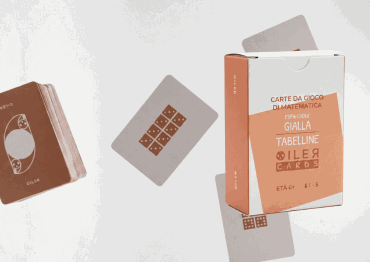
The Yellow expansion of OILER CARDS is made up of 100 cards that explore the multiplication tables. Each card shows a specific multiplication from the multiplication square, presenting the number as the product of two factors. The deck is designed to support learning the multiplication tables and to foster understanding of multiplication, offering an immediate visual reference for the multiplicative decomposition of numbers.
WAR

2-4 players
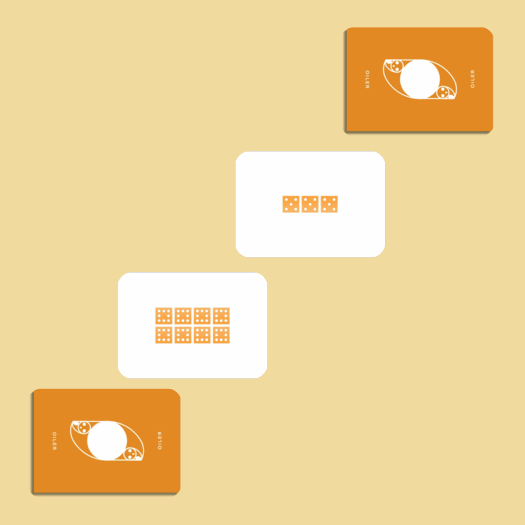
The deck is split among the players into piles with the same number of cards. Each player keeps their pile face down without looking at the cards. On each turn, the players turn over the top card of their pile and work out the result of the multiplication shown. Whoever has the card with the highest product wins the turn: they take the other players' cards and put them at the bottom of their pile together with their own.
In the event of a tie, that is, when the results of the multiplications are the same (for example, 3x4 against 4x3, or 3x4 against 2x6), the players involved shout "War!", place four cards face down on the table and turn over the fifth. Whoever has the highest product among these fifth cards wins the turn and takes all the cards on the table, putting them at the bottom of their pile. Whoever runs out of cards loses: the last player left wins the game.
The game can be played at different levels of difficulty, starting with only the easiest multiplication tables or those already covered in class, and gradually increasing the number of cards.
MEMORY
1-4 players
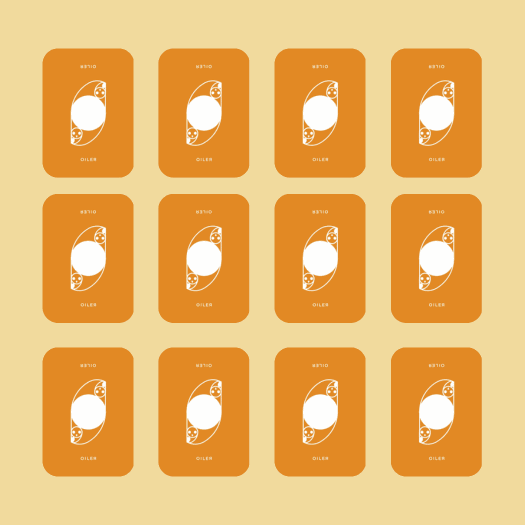
Prepare the cards by choosing from the deck a number of pairs based on the commutative property, such as 3x4 and 4x3. We suggest starting with 20 cards in all (10 pairs). The cards are shuffled and laid out face down on the table in neat rows.
Taking turns, each player turns over two cards so that everyone can see them. If the two cards form a commutative pair (they have the same factors but in reverse order), the player collects them, puts them in their own pile and plays another turn. If the cards do not form a pair, the player shows them to the opponents and turns them face down again in their original position, and the turn passes to the next player. When there are no cards left on the table, the player who has collected the most pairs wins.
Taking turns, each player turns over two cards so that everyone can see them. If the two cards form a commutative pair (they have the same factors but in reverse order), the player collects them, puts them in their own pile and plays another turn. If the cards do not form a pair, the player shows them to the opponents and turns them face down again in their original position, and the turn passes to the next player. When there are no cards left on the table, the player who has collected the most pairs wins.