Sets, quantifiers, argumentation



Data Sheet

CLASSES: 6, 7 and 8.
Skills:
The pupil:
- supports their own beliefs with suitable examples and counterexamples and with chains of statements, and is willing to change their mind when they recognise the logical consequences of a correct argument;
- produces arguments based on the theoretical knowledge acquired (for example, can use the concepts of characterising property and of definition);
- uses and interprets mathematical language (Cartesian plane, formulas, equations, ...) and grasps its relationship with natural language.
METHODS:
The pathway deals with how we express ourselves and reason. Great attention is paid to a conscious use of everyday language, especially expressions with a logical value. The relationship between logic, language and mathematical reasoning is crucial: at every school level it is important to make explicit the forms of reasoning and how a statement is built (Durand-Guerrier, 2021). Here the focus is on the role of quantifiers (all, at least, at most, none) and their negation. The pathway suggests using the corresponding symbols (always alongside natural language) to build, with the class, a shared logical and mathematical language for describing the properties of sets.
MULTIDISCIPLINARY LINKS:
English.
This pathway was designed by Matteo Acclavio, Giulia Balboni, Emmanuel Beffara and Luigi Bernardi.

Data Sheet
CLASSES: 6, 7 and 8.
Skills:
The pupil:
- supports their own beliefs with suitable examples and counterexamples and with chains of statements, and is willing to change their mind when they recognise the logical consequences of a correct argument;
- produces arguments based on the theoretical knowledge acquired (for example, can use the concepts of characterising property and of definition);
- uses and interprets mathematical language (Cartesian plane, formulas, equations, ...) and grasps its relationship with natural language.
METHODS:
The pathway deals with how we express ourselves and reason. Great attention is paid to a conscious use of everyday language, especially expressions with a logical value. The relationship between logic, language and mathematical reasoning is crucial: at every school level it is important to make explicit the forms of reasoning and how a statement is built (Durand-Guerrier, 2021). Here the focus is on the role of quantifiers (all, at least, at most, none) and their negation. The pathway suggests using the corresponding symbols (always alongside natural language) to build, with the class, a shared logical and mathematical language for describing the properties of sets.
MULTIDISCIPLINARY LINKS:
English.
This pathway was designed by Matteo Acclavio, Giulia Balboni, Emmanuel Beffara and Luigi Bernardi.
Ernst Zermelo

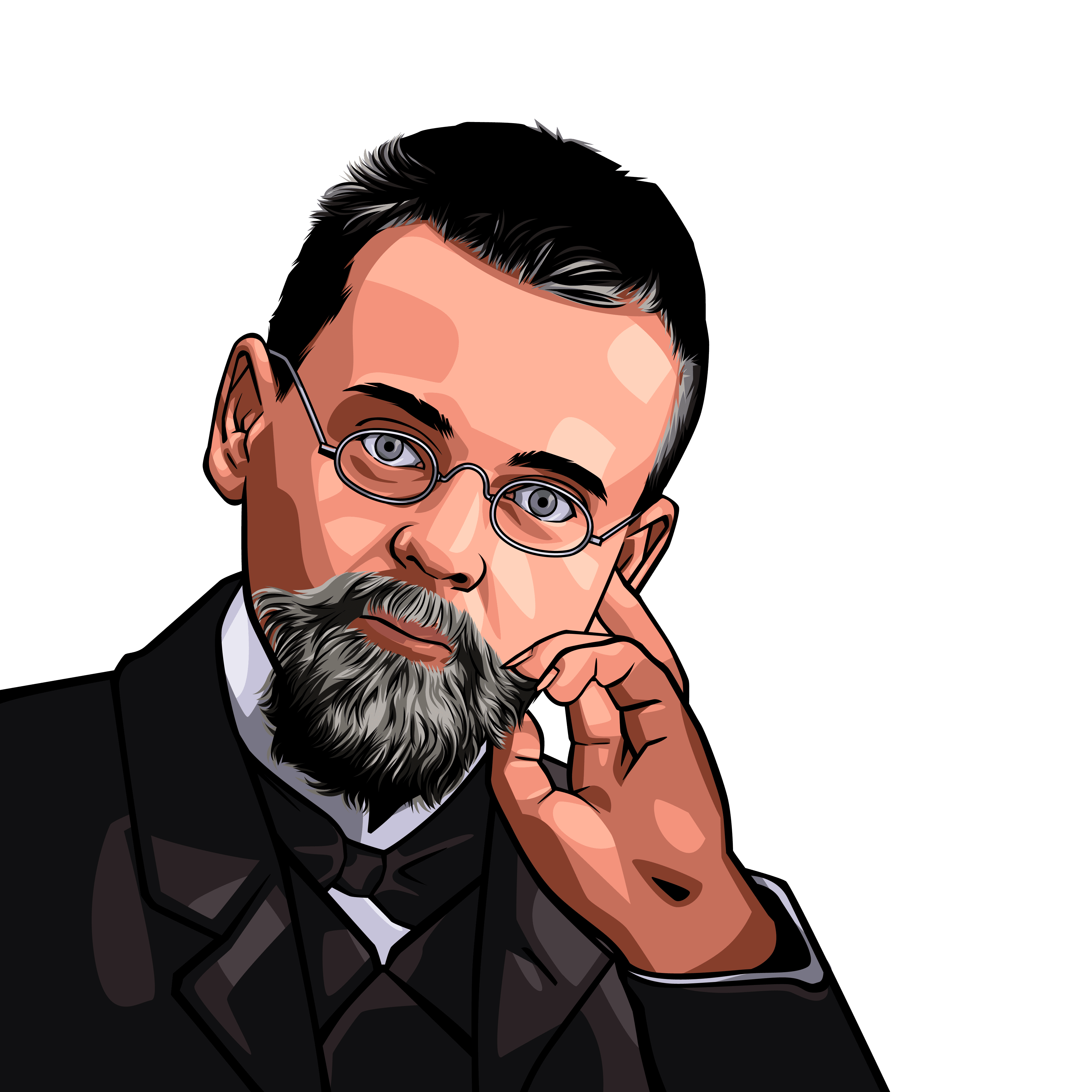 Ernst Zermelo was a German mathematician and philosopher. At first he worked in physics, but then, after hearing a lecture by David Hilbert, he changed his mind. In that 1900 lecture Hilbert, a very well-known and respected mathematician, listed twenty-three problems that deserved to be studied in depth and whose solution would make mathematics take great steps forward. Many of these problems have since been solved, and the others have led to interesting developments and research. Prompted by the first of those problems, Zermelo decided to devote himself to set theory and logic, and he went on to formulate the axiom of choice, one of the most controversial statements in mathematics (even mathematics has controversial statements!).
To place the axiom of choice and its consequences in a clear and rigorous framework, Zermelo had to make the foundations of set theory precise. Just as geometry rests on Euclid's axioms, to be truly rigorous set theory must also rest on a few axioms that state which constructions are allowed and which are not. In this way Zermelo managed to overcome Russell's paradox and other paradoxes that arise when set theory is studied at an intuitive level.