Geometry and art


Data Sheet

CLASSES: 1 to 5.
Skills:
The pupil:
- recognises and represents shapes in the plane and in space, and relationships and structures found in nature or made by people;
- describes, names and classifies figures by their geometric properties.
METHODS:
The central theme of the pathway is observation. The idea is to guide pupils from the overall view of a picture to the single parts that make it up (Kellogg, 1969, Analyzing Children's Art), which can be sketched and then reproduced. Then they go back to the picture as a whole in order to get to know, through a guided investigation, the object represented. The pathway is cross-curricular and uses different methods, including some simple drawing techniques (drawing freehand, not using a rubber, ...).
MULTIDISCIPLINARY LINKS:
art and design, technology.
This pathway was designed by Luigi Bernardi, Martina Carbone, Giorgia Damiano and Marta Menghini.
No activities yet: more are coming soon!
No activities yet: more are coming soon!
Data Sheet
CLASSES: 1 to 5.
Skills:
The pupil:
- recognises and represents shapes in the plane and in space, and relationships and structures found in nature or made by people;
- describes, names and classifies figures by their geometric properties.
METHODS:
The central theme of the pathway is observation. The idea is to guide pupils from the overall view of a picture to the single parts that make it up (Kellogg, 1969, Analyzing Children's Art), which can be sketched and then reproduced. Then they go back to the picture as a whole in order to get to know, through a guided investigation, the object represented. The pathway is cross-curricular and uses different methods, including some simple drawing techniques (drawing freehand, not using a rubber, ...).
MULTIDISCIPLINARY LINKS:
art and design, technology.
This pathway was designed by Luigi Bernardi, Martina Carbone, Giorgia Damiano and Marta Menghini.
Artemisia Gentileschi

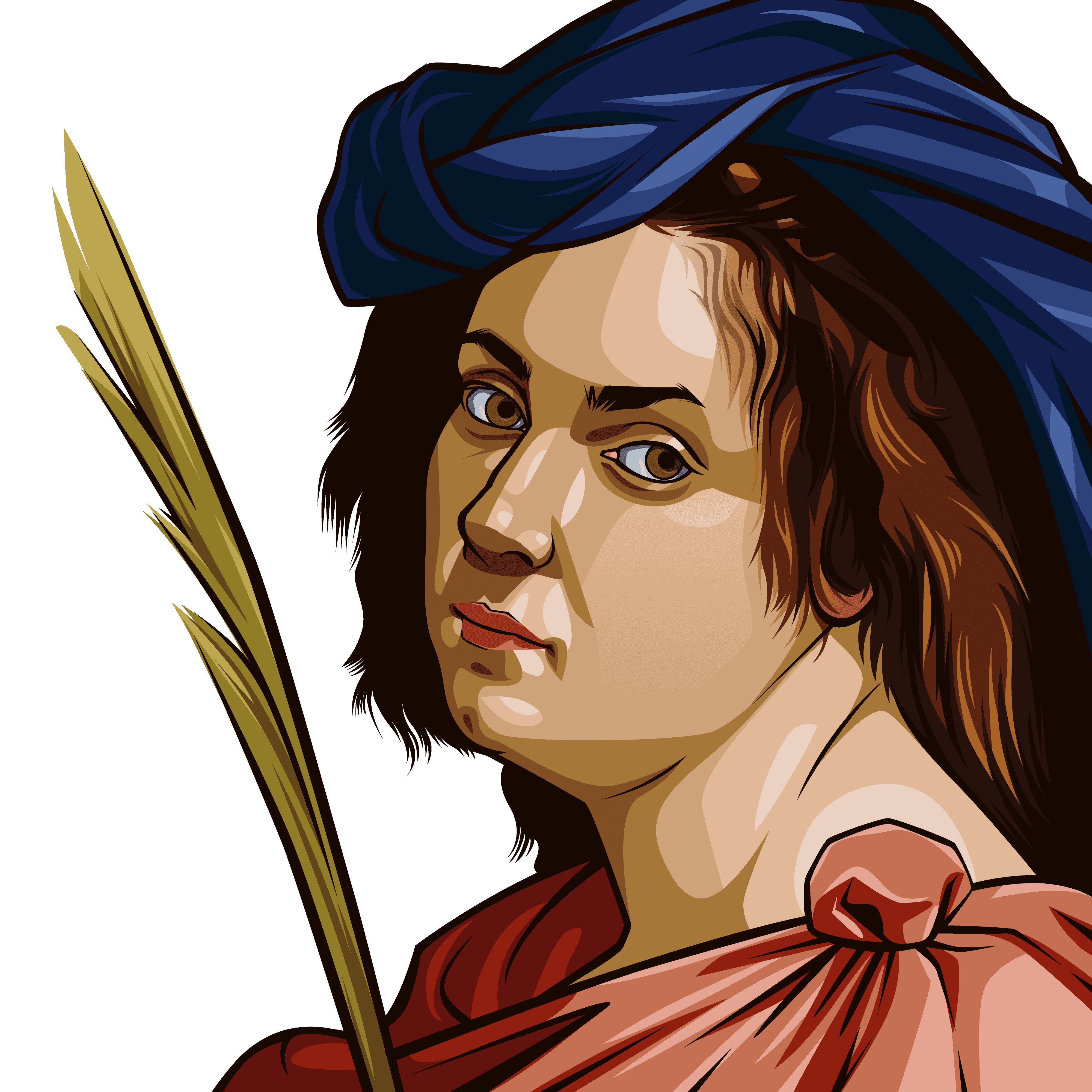 Artemisia Gentileschi, a painter, or “pittora” as she called herself, began working very young in the workshop of her father Orazio, also a painter, together with her brothers. She soon showed her talent but, being a woman, she was forced to practise her art mostly at home or in the workshop. So she trained by copying the works she found in her father's studio. Like her father, she was influenced by Caravaggio and by painting from real models. This influence can be seen from her very first works, the first of which she painted at 16, depicting biblical heroines: the images are not idealised and express all the drama of the situation.
A major turning point in her life came when she was raped, at home, by the very master her father had chosen to teach her perspective. With great courage, and with her father's help, she went through the ordeal of a trial (enormous for a woman of that time) to have her rapist convicted.
After this, in 1612, she married and moved to Florence, where she began a new life at the court of Cosimo de' Medici. There she established herself as a painter and became the only woman member of the prestigious Accademia delle Arti del Disegno. She met Galileo Galilei, who frequented Cosimo's court and the Accademia. With Galileo she began a close correspondence that also shows her interest in science. For example, the four phases of the Moon, drawn realistically for the first time by Galileo, are represented symbolically in the four female figures of Bathsheba at Her Bath (see Pamela del Bianco, 2021). The second of her two paintings of Judith Slaying Holofernes, from 1620, may also show Galileo's influence: to the harshness of the image she adds the spurt of blood, whose trajectory seems to obey the laws of physics.
Her resolute nature led Artemisia to move again, this time to Naples, followed by her husband and children. In Naples she broadened her work, painting canvases for a church too. She stayed in Naples until her death. Her correspondence with Galileo did not stop with the move: as late as 1635 she asked an elderly Galileo for advice.
“The two revolutionary destinies often met, intertwined and illuminated each other, bringing to light what only innovative thinking and fervent passion can show the world, beyond the fixed patterns and stereotypes of every age.” Pamela del Bianco, Un'amicizia rivoluzionaria: Artemisia Gentileschi e Galileo Galilei