
2P GAME

How to play

TWO-PLAYER GAMES brings together six games from the LOVLEIS pathway. Two people can play on the same device, or you can play against the computer, which can move at random, at a basic level or following an optimal strategy. Before each game, choose the game, the variant and who starts: the rules of each game are below.

Tic-tac-toe

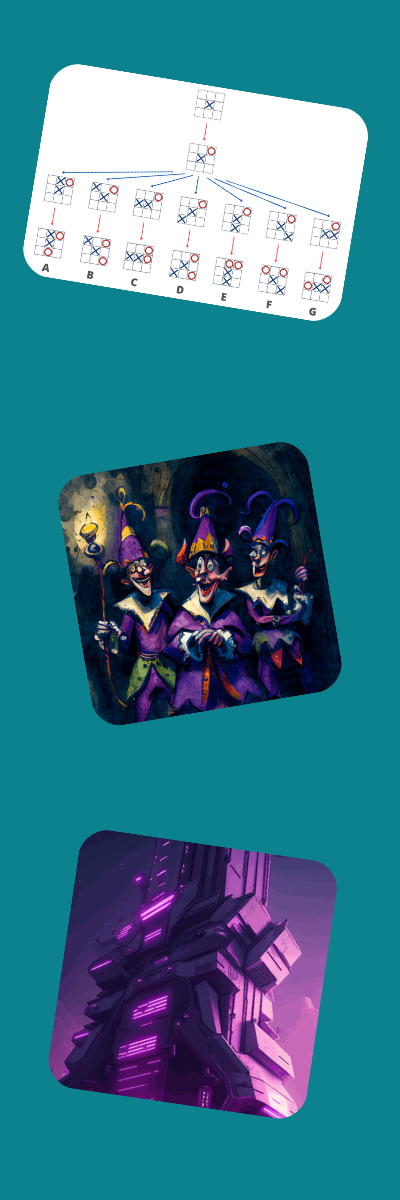
You play on a 3 × 3 grid. The first player uses × and the second ○; taking turns, each player fills an empty cell. The first to line up three symbols horizontally, vertically or diagonally wins; if the grid fills up with no line of three, it is a draw.

Crazy: on each move you choose whether to place × or ○. The first to complete a line of three matching symbols wins, whatever the symbol.

Ultimate tic-tac-toe: nine small grids make up a big one. You win a small grid by making three in a row inside it, and the game by winning three small grids in a row. The cell you play in sends your opponent to the matching grid; if that grid is already won or full, they may choose any open grid. A full small grid with no three in a row counts for nobody; if every small grid is closed without three in a row, the game is a draw.


Pick15

The numbers 1 to 9 are on the table. Taking turns, each player takes a number that is still free. The first player to hold three numbers that add up to 15 wins: it takes three numbers, not the total of all the numbers taken.

Morris

Three Men’s Morris: each player has three pieces. First they are placed in turn on empty points, then you move one of your pieces along a segment to a neighbouring empty point. The first to line up three pieces, diagonals included, wins. If the game goes on forever, it is a draw.

Nine Men’s Morris: each player has nine pieces. Lining up three pieces forms a mill and lets you remove an opposing piece that is not part of a mill (any piece, if all of them are). Once all pieces are placed, they move along the segments; a player left with three pieces may jump to any empty point. A player left with two pieces or no moves loses. If the game goes on forever, it is a draw.

Take Away

You start with a heap of pieces. Taking turns, players remove from 1 up to a set maximum of pieces: whoever takes the last one wins. Before playing, choose how many pieces are in play (from 1 to 100, normally 20) and the most that can be removed in one move (normally 4).

Nim

The pieces are laid out in rows. Taking turns, players remove as many pieces as they like, at least one, but from a single row. Before playing, choose the starting rows: 1, 3, 5 and 7 pieces (the classic layout), 1, 3 and 5, 1, 3, 5, 7 and 9, or two rows of 10. In the classic version whoever takes the last piece loses; in the misère variant, they win.

Soldiers’ Game

Three soldiers try to trap a runner. The soldiers move first; taking turns, a piece moves along a segment to a neighbouring empty point. Soldiers cannot move to the right, while the runner moves in any direction. The soldiers win if the runner can no longer move; if they cannot trap him, the game goes on forever. If it is the soldiers’ turn and none of them can move, the runner wins.

Misère

In every game except the Soldiers’ Game you can choose the misère variant, which turns the result upside down: in Tic-tac-toe, for example, whoever makes three in a row loses. In Nim, where in the classic version whoever takes the last piece loses, in misère whoever takes it wins.

Against the computer

Against the computer you also choose the level. Random: it picks any move. Basic: it wins at once if it can, avoids moves that lose at once, and otherwise moves at random. Optimal: it follows an optimal strategy, worked out by examining every possible game. In Ultimate tic-tac-toe and Nine Men’s Morris there are too many possible games: the strongest level is called Advanced and explores many continuations, but does not guarantee perfect play.

Strategy tree

Soon you will be able to explore the strategy tree of each game, in collaboration with Andrea Ponticelli and Laboratorio A.L.I.D.A.

Would you like to play these games with your class?

LOVLEIS at primary More software

An Oiler project, in collaboration with Andrea Ponticelli and Laboratorio A.L.I.D.A.

Discover Laboratorio A.L.I.D.A. ↗